Table of Contents
- What Virtual CFO Services for Startups Actually Cover
- When to Hire a CFO for a Startup: Timing Signals That Matter
- Outsourced CFO vs. In-House CFO: A Direct Comparison
- Startup Financial Modeling Services: What Good Looks Like
- Virtual CFO Pricing Models: What Startups Pay and Why
- Red Flags and Vetting Criteria for Virtual CFO Services for Startups
- Fundraising, Investor Relations, and Pitch Deck Support
- Conclusion
Last Updated: August 3, 2026
Founders who delay getting financial leadership often discover the hard way that virtual cfo services for startups are not a luxury reserved for later-stage companies. At Paldino Company CPA, we work with early-stage entrepreneurs and small business owners who consistently underestimate how much damage poor financial visibility does before their first major fundraise. The gap between a startup that closes a Series A and one that stalls is rarely the product. It is almost always the financial infrastructure behind it. Below, we break down exactly what these services cover, when to engage them, and how to vet providers so you do not waste money on the wrong fit.
What Virtual CFO Services for Startups Actually Cover
A virtual CFO is a senior finance professional who provides strategic financial leadership on a fractional or outsourced basis, without the overhead of a full-time hire. Virtual CFO services for startups typically span financial modeling, cash flow optimization, investor reporting, regulatory compliance, tax planning, and strategic advisory. This is not bookkeeping with a fancier title. A virtual CFO sits in board meetings, challenges your assumptions on unit economics, and tells you when your burn rate is unsustainable before your runway disappears.
Core Responsibilities: From Financial Modeling to Investor Reporting
The day-to-day work of a virtual CFO covers high-stakes functions:
- Financial modeling and forecasting: Building dynamic models that project revenue, expenses, and capital needs across multiple scenarios
- Burn rate and runway analysis: Calculating how long current cash reserves last under different growth assumptions
- Budget variance analysis: Comparing actual performance to plan and explaining the gaps
- Investor reporting: Preparing monthly or quarterly packages that give investors clean visibility into financial health
- Cash flow management: Monitoring receivables, payables, and working capital to prevent liquidity surprises
- FP&A support: Translating raw financial data into the strategic insights founders need for decisions
- Pitch deck financials: Building the financial slides that underpin fundraising narratives
- Tax planning and compliance: Coordinating with CPAs to minimize tax exposure and stay current with regulatory requirements
How a Virtual CFO Differs from a Bookkeeper or Controller
A bookkeeper records transactions. A controller ensures those transactions are accurate and produces financial statements. A virtual CFO uses those statements to drive strategy. Many startups hire a bookkeeper and assume their finances are "handled," then walk into an investor meeting with no coherent story about their CAC/LTV ratio, monthly recurring revenue trends, or Series A preparation timeline. A virtual CFO bridges the gap between compliance-level accounting and the financial transparency that investors and lenders actually require.
When to Hire a CFO for a Startup: Timing Signals That Matter
Knowing when to hire a CFO for a startup is one of the most consequential decisions founders make. The clearest signal is complexity, not revenue. When your financial decisions start requiring scenario modeling rather than gut instinct, you need a CFO. Other concrete triggers include:
- Preparing for a seed or Series A fundraise
- Managing equity management and cap table complexity
- Hiring employees and dealing with payroll, benefits, and labor cost management
- Entering contracts that involve milestone-based payments or deferred revenue
- Needing to present audited or reviewed financials to a partner or investor
Pre-Seed Through Series A: Stage-by-Stage Decision Framework
| Stage | Primary Need | Virtual CFO Focus |
|---|---|---|
| Pre-Seed | Clean books, basic runway model | Financial controls, bookkeeping oversight |
| Seed | Investor reporting, burn rate tracking | Cash flow optimization, pitch deck financials |
| Series A Prep | FP&A, due diligence readiness | Financial modeling, data room setup |
| Post-Series A | Board reporting, growth strategy | Budget variance analysis, capital allocation |
Pre-seed founders often need basic financial hygiene more than strategic advisory. Seed-stage companies need someone who can speak investor language and build the financial narrative for the next raise. By Series A preparation, you need a virtual CFO who can run a clean due diligence process, because sophisticated investors will pull apart your financial model line by line.
Outsourced CFO vs. In-House CFO: A Direct Comparison
The case for an outsourced CFO over a full-time hire is compelling at most startup stages. A full-time CFO commands a significant salary, equity, and benefits package. For early-stage companies, that cost is not justifiable when the CFO function is needed for a fraction of the working week. An outsourced CFO delivers senior-level expertise at a fraction of that cost, with the added benefit of scalability: you can increase engagement hours ahead of a fundraise and pull back during quieter periods.
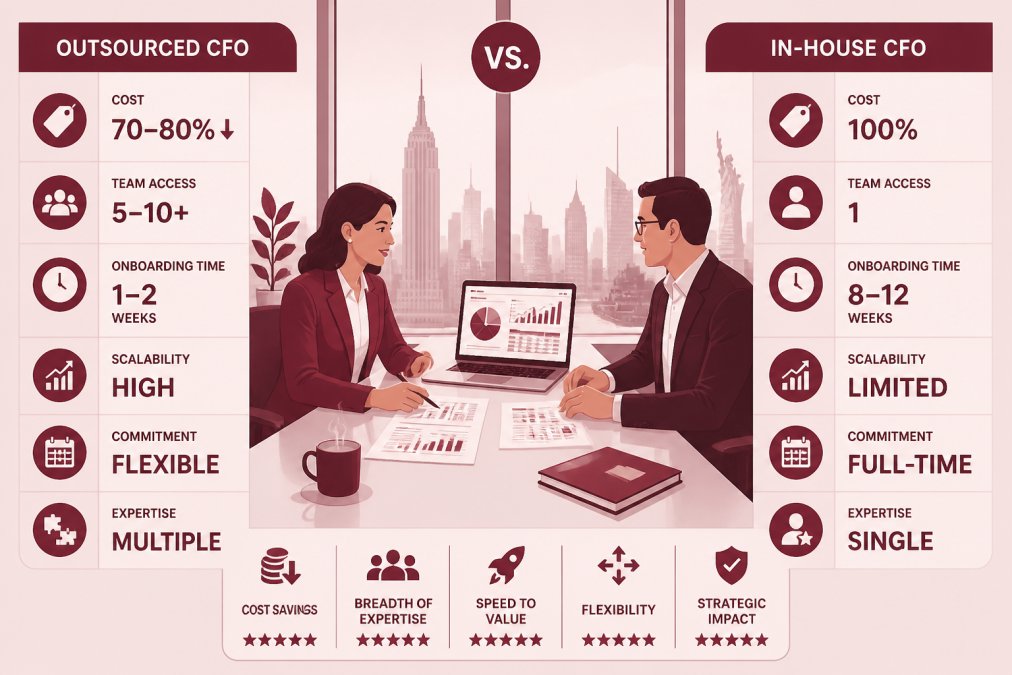
The trade-off is depth of integration. A full-time CFO is embedded in your culture and builds institutional knowledge over years. An outsourced CFO operates on a defined scope and may miss informal signals. For most startups before Series B, that trade-off strongly favors the outsourced model.
| Factor | Virtual / Outsourced CFO | Full-Time CFO |
|---|---|---|
| Cost | Fraction of full-time cost | High salary plus equity |
| Availability | Defined hours, scalable | Full-time presence |
| Expertise breadth | Cross-industry experience | Deep company-specific knowledge |
| Scalability | Adjusts to stage | Fixed headcount |
| Best for | Pre-seed through Series A | Post-Series B and beyond |
According to SCORE's small business financial guidance resources, most early-stage businesses significantly overspend on administrative overhead before establishing a clear financial strategy. Fractional leadership models address this directly by matching cost to actual need.
Startup Financial Modeling Services: What Good Looks Like
Most startup financial models are either too simple to be useful or too complex to be trusted. Good financial modeling lives in the middle: detailed enough to answer real questions and transparent enough that an investor can audit the assumptions in thirty minutes. A credible financial model includes revenue build by segment, a headcount plan tied to operational milestones, a working capital schedule, and scenario analysis showing what happens if growth is 30% below plan.
Cash Flow Optimization, Burn Rate, and Runway Projections
Burn rate is the single most important number for most pre-revenue and early-revenue startups. Gross burn tells you total monthly cash out. Net burn tells you what you are actually losing after revenue. Runway is simply your current cash divided by net burn. A virtual CFO builds a rolling 13-week cash flow forecast that flags potential shortfalls before they become crises.
Unit Economics, CAC/LTV, and Budget Variance Analysis
Unit economics are the foundation of any credible growth story. Customer Acquisition Cost and Lifetime Value are the two numbers investors interrogate most aggressively, because they reveal whether your business model actually works at scale. A virtual CFO builds the CAC/LTV model from first principles: what does it actually cost to acquire a customer across every channel, and how long does a customer stay before churning? Budget variance analysis then closes the loop by comparing what you planned to spend on acquisition against what you actually spent.
Harvard Business Review's analysis of startup financial discipline consistently identifies poor unit economics tracking as a leading predictor of startup failure in growth stages.
Virtual CFO Pricing Models: What Startups Pay and Why
Pricing for virtual cfo services for startups varies considerably based on scope, stage, and provider model. Most providers use one of three models:
- Monthly retainer: A fixed fee for a defined scope of work, typically covering a set number of hours and deliverables.
- Project-based: A flat fee for a specific engagement such as building a financial model, preparing for a fundraise, or setting up financial reporting infrastructure.
- Hourly or time-and-materials: Less common for ongoing CFO work, but used for advisory engagements or one-time analyses.
Platforms like Zeni start their CFO services at $1,500 per month, while Ignite Spot begins at $950 per month for smaller businesses. GrowthLab Financial Services also starts at $1,500 per month. For Paldino Company CPA's virtual CFO services, pricing depends on the scope of engagement and your business's specific needs. The best approach is to schedule a direct conversation to get a proposal calibrated to your stage.
Red Flags and Vetting Criteria for Virtual CFO Services for Startups
Choosing the wrong virtual CFO is expensive in ways that go beyond the monthly fee. A bad fit can produce misleading financial models, create friction with investors, or leave your financial controls in worse shape than before. The most important vetting criteria:
- Startup-specific experience: CFOs who have only worked with established businesses often lack familiarity with venture mechanics, equity management, or the specific investor reporting formats that seed and Series A investors expect.
- Industry relevance: A SaaS CFO and a consumer goods CFO are solving different problems. Make sure the provider has worked with businesses in your sector.
- References from funded companies: Ask for references from founders who went through a fundraise with this CFO. That is the real test.
- Clear deliverables: Vague engagements produce vague results. A strong provider defines exactly what you will receive each month.
- Tech stack fluency: If your provider cannot work with your existing tools, you will spend the first three months on cleanup instead of strategy.

Tech Stack Integration: QuickBooks, Dashboards, and Reporting Tools
Virtual CFO services for startups only deliver value if the financial data flowing into the CFO's analysis is accurate and current. Your virtual CFO needs to work fluently within your existing tech stack rather than forcing a migration. QuickBooks is the dominant accounting platform for small businesses and early-stage startups. A virtual CFO who cannot clean up a messy QuickBooks file, reconfigure the chart of accounts, or pull the reports needed for investor packages will create bottlenecks. Paldino Company CPA works directly with QuickBooks, which means there is no "start from scratch" requirement even if your books have accumulated errors.
Exit Strategy Planning and Investor Readiness
A virtual CFO who is thinking about your exit from day one will structure your financial reporting, equity management, and capital allocation in ways that maximize valuation when the time comes. That means clean, auditable financials, a documented history of financial controls, and a financial model that tells a coherent story across multiple years. Before any fundraise, your virtual CFO should conduct a pre-diligence review: stress-testing your financial model, identifying gaps in your data room, and making sure your pitch deck financials are defensible under scrutiny.
Fundraising, Investor Relations, and Pitch Deck Support
Fundraising support is where virtual CFO services for startups deliver some of their most tangible value. A virtual CFO who understands seed funding and Series A preparation brings more than spreadsheet skills to a fundraise. They know what investors will ask, which assumptions will get challenged first, and how to structure the financial narrative so it supports rather than undermines the business story.
Specific deliverables in a fundraising engagement typically include:
- A three- to five-year financial model with clearly documented assumptions
- Sensitivity analysis showing performance under bear, base, and bull scenarios
- A data room with organized financial history, cap table, and supporting documents
- Financial slides for the pitch deck that connect to the underlying model
- Preparation for investor Q&A on unit economics, growth strategy, and capital allocation
According to the SEC's guidance on startup financial disclosures and investor reporting, accurate and transparent financial reporting is not just best practice for fundraising. It is a legal requirement once you begin soliciting investors under certain exemptions. A virtual CFO who understands both the strategic and compliance dimensions of fundraising is worth considerably more than one who only handles the modeling.
Most founders reach a point where financial decisions are outpacing their ability to manage them alone. Virtual CFO services provide the senior-level expertise to close that gap without the cost of a full-time hire. Paldino Company CPA offers virtual CFO services built around the specific needs of New York and Westchester County entrepreneurs: QuickBooks integration, year-round financial support, and a human-centered approach that treats your business as more than a set of numbers. Schedule an appointment with Paldino Company CPA to get clarity on your financial position and a plan built around where you are actually going.
Frequently Asked Questions
What is included in virtual CFO services for startups?
Virtual CFO services for startups typically include financial modeling, cash flow management, budgeting and forecasting, burn rate analysis, runway projections, and fundraising support such as pitch deck review and investor reporting. Many providers also cover tax planning, regulatory compliance, financial statement analysis, and strategic advisory work. The exact scope varies by provider and engagement tier, so confirm deliverables before signing any agreement.
At what stage should a startup hire a virtual CFO?
Most startups benefit from virtual CFO services once they are preparing for seed funding or approaching Series A. At that point, investors expect clean financials, credible projections, and clear unit economics like CAC/LTV ratios. Earlier-stage founders handling under $500K in annual revenue may only need bookkeeping, but once capital allocation decisions, equity management, or fundraising conversations start, fractional CFO-level guidance becomes worth the cost.
How much do virtual CFO pricing models typically cost?
Virtual CFO pricing models range from monthly retainers to project-based fees. Based on publicly available data from providers in our research, starting prices range from roughly $950 per month at entry-level services to $1,500 per month or more for platforms with integrated bookkeeping, tax, and CFO functions. Many specialized firms do not publish pricing and require a custom quote. Scope, company size, and service depth all affect the final figure.
How does a virtual CFO differ from a bookkeeper?
A bookkeeper records transactions and maintains accurate ledgers. A virtual CFO interprets that data to inform strategy: forecasting cash flow, modeling growth scenarios, managing investor relations, and advising on capital structure. Bookkeeping is backward-looking; CFO work is forward-looking. Many startups need both, and some virtual CFO providers bundle outsourced accounting with senior-level financial leadership so the two functions stay aligned.
How does a virtual CFO help with fundraising and investor relations?
A virtual CFO prepares the financial infrastructure investors scrutinize during due diligence: three-statement models, pitch deck financials, data room organization, and monthly recurring revenue dashboards. They also help founders tell a coherent financial story, set realistic milestones, and respond to investor questions with credible numbers. Providers like Pilot and Ignition CPAs specifically cite fundraising support, including seed funding preparation and Series A readiness, as core service components.
Can a virtual CFO work with my existing QuickBooks setup?
Yes. Most virtual CFO providers are fluent in QuickBooks and will assess your current books, identify errors, and clean up the data before building any forecasts or reports on top of it. Starting from scratch is rarely necessary. Providers such as Paragon Accounting Solutions explicitly offer QuickBooks consulting, cleanup, and training as part of their service. Confirm tech stack compatibility during your initial consultation so there are no integration surprises.
What is the difference between a fractional CFO and a virtual CFO?
The terms are often used interchangeably. Both describe a part-time, senior-level finance executive who works with multiple clients rather than one company full-time. 'Fractional' emphasizes the part-time ownership of the CFO role; 'virtual' emphasizes remote delivery. In practice, a fractional CFO service delivered remotely is a virtual CFO service. What matters more than the label is the provider's experience with your stage, industry, and specific financial challenges.
This article was written using GrandRanker