Paldino Company CPA - "Success Starts with a Handshake"

Welcome to my blog page the purpose of which is to provide you with timely and relevant tax and accounting information. I intend to bring you information which you can use now to assist you in lowering you income taxes. I will when appropriate give you links to tax related web-sites, worksheets and check-list to assist you in meeting you recording keeping requirements and provide you with the information you need to prepare an accurate return and pay the least amount of tax you are legally required to pay. Please check back often and feel free to post your questions and comments


Monday, August 3, 2026

Virtual CFO Services for Startups: A 2026 Guide

Table of Contents

Last Updated: August 3, 2026

Founders who delay getting financial leadership often discover the hard way that virtual cfo services for startups are not a luxury reserved for later-stage companies. At Paldino Company CPA, we work with early-stage entrepreneurs and small business owners who consistently underestimate how much damage poor financial visibility does before their first major fundraise. The gap between a startup that closes a Series A and one that stalls is rarely the product. It is almost always the financial infrastructure behind it. Below, we break down exactly what these services cover, when to engage them, and how to vet providers so you do not waste money on the wrong fit.

What Virtual CFO Services for Startups Actually Cover

A virtual CFO is a senior finance professional who provides strategic financial leadership on a fractional or outsourced basis, without the overhead of a full-time hire. Virtual CFO services for startups typically span financial modeling, cash flow optimization, investor reporting, regulatory compliance, tax planning, and strategic advisory. This is not bookkeeping with a fancier title. A virtual CFO sits in board meetings, challenges your assumptions on unit economics, and tells you when your burn rate is unsustainable before your runway disappears.

Core Responsibilities: From Financial Modeling to Investor Reporting

The day-to-day work of a virtual CFO covers high-stakes functions:

  • Financial modeling and forecasting: Building dynamic models that project revenue, expenses, and capital needs across multiple scenarios
  • Burn rate and runway analysis: Calculating how long current cash reserves last under different growth assumptions
  • Budget variance analysis: Comparing actual performance to plan and explaining the gaps
  • Investor reporting: Preparing monthly or quarterly packages that give investors clean visibility into financial health
  • Cash flow management: Monitoring receivables, payables, and working capital to prevent liquidity surprises
  • FP&A support: Translating raw financial data into the strategic insights founders need for decisions
  • Pitch deck financials: Building the financial slides that underpin fundraising narratives
  • Tax planning and compliance: Coordinating with CPAs to minimize tax exposure and stay current with regulatory requirements

How a Virtual CFO Differs from a Bookkeeper or Controller

A bookkeeper records transactions. A controller ensures those transactions are accurate and produces financial statements. A virtual CFO uses those statements to drive strategy. Many startups hire a bookkeeper and assume their finances are "handled," then walk into an investor meeting with no coherent story about their CAC/LTV ratio, monthly recurring revenue trends, or Series A preparation timeline. A virtual CFO bridges the gap between compliance-level accounting and the financial transparency that investors and lenders actually require.

When to Hire a CFO for a Startup: Timing Signals That Matter

Knowing when to hire a CFO for a startup is one of the most consequential decisions founders make. The clearest signal is complexity, not revenue. When your financial decisions start requiring scenario modeling rather than gut instinct, you need a CFO. Other concrete triggers include:

  • Preparing for a seed or Series A fundraise
  • Managing equity management and cap table complexity
  • Hiring employees and dealing with payroll, benefits, and labor cost management
  • Entering contracts that involve milestone-based payments or deferred revenue
  • Needing to present audited or reviewed financials to a partner or investor

Pre-Seed Through Series A: Stage-by-Stage Decision Framework

Stage Primary Need Virtual CFO Focus
Pre-Seed Clean books, basic runway model Financial controls, bookkeeping oversight
Seed Investor reporting, burn rate tracking Cash flow optimization, pitch deck financials
Series A Prep FP&A, due diligence readiness Financial modeling, data room setup
Post-Series A Board reporting, growth strategy Budget variance analysis, capital allocation

Pre-seed founders often need basic financial hygiene more than strategic advisory. Seed-stage companies need someone who can speak investor language and build the financial narrative for the next raise. By Series A preparation, you need a virtual CFO who can run a clean due diligence process, because sophisticated investors will pull apart your financial model line by line.

Pro Tip If you are using QuickBooks and your chart of accounts has never been reviewed by a senior finance professional, fix that before you approach any investor. Messy books signal operational immaturity faster than almost anything else.

Outsourced CFO vs. In-House CFO: A Direct Comparison

The case for an outsourced CFO over a full-time hire is compelling at most startup stages. A full-time CFO commands a significant salary, equity, and benefits package. For early-stage companies, that cost is not justifiable when the CFO function is needed for a fraction of the working week. An outsourced CFO delivers senior-level expertise at a fraction of that cost, with the added benefit of scalability: you can increase engagement hours ahead of a fundraise and pull back during quieter periods.
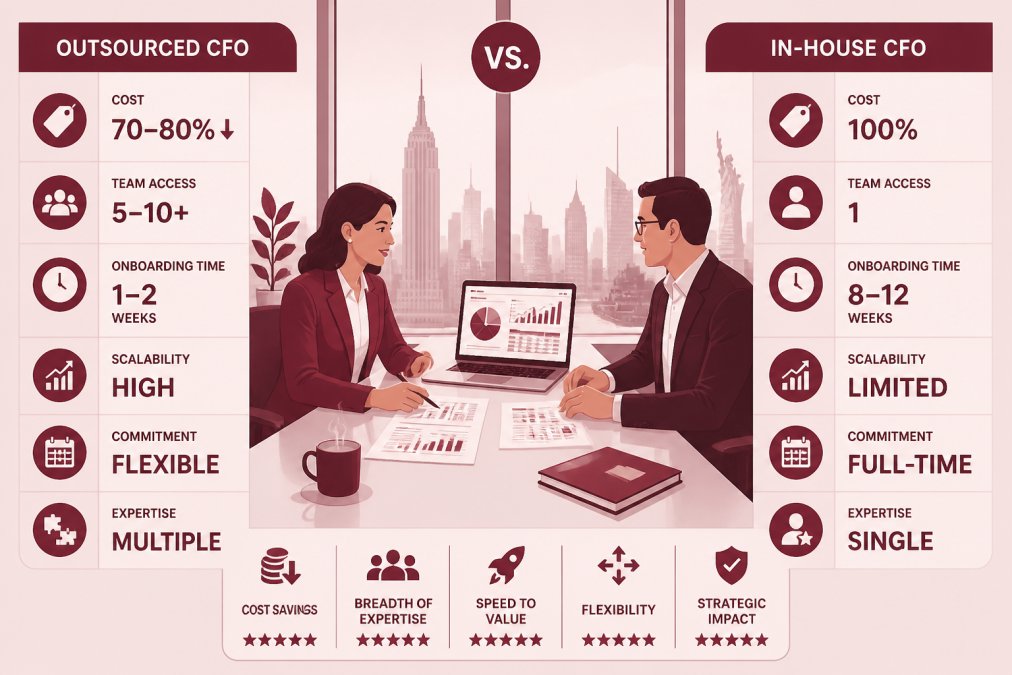
Two professionals sitting across from each other at a modern office table reviewing financial documents and a laptop, bright natural light from floor-to-ceiling windows suggesting a strategic advisory conversation in a contemporary New York office

The trade-off is depth of integration. A full-time CFO is embedded in your culture and builds institutional knowledge over years. An outsourced CFO operates on a defined scope and may miss informal signals. For most startups before Series B, that trade-off strongly favors the outsourced model.

Factor Virtual / Outsourced CFO Full-Time CFO
Cost Fraction of full-time cost High salary plus equity
Availability Defined hours, scalable Full-time presence
Expertise breadth Cross-industry experience Deep company-specific knowledge
Scalability Adjusts to stage Fixed headcount
Best for Pre-seed through Series A Post-Series B and beyond

According to SCORE's small business financial guidance resources, most early-stage businesses significantly overspend on administrative overhead before establishing a clear financial strategy. Fractional leadership models address this directly by matching cost to actual need.

Startup Financial Modeling Services: What Good Looks Like

Most startup financial models are either too simple to be useful or too complex to be trusted. Good financial modeling lives in the middle: detailed enough to answer real questions and transparent enough that an investor can audit the assumptions in thirty minutes. A credible financial model includes revenue build by segment, a headcount plan tied to operational milestones, a working capital schedule, and scenario analysis showing what happens if growth is 30% below plan.

Cash Flow Optimization, Burn Rate, and Runway Projections

Burn rate is the single most important number for most pre-revenue and early-revenue startups. Gross burn tells you total monthly cash out. Net burn tells you what you are actually losing after revenue. Runway is simply your current cash divided by net burn. A virtual CFO builds a rolling 13-week cash flow forecast that flags potential shortfalls before they become crises.

Watch Out Startups that manage burn rate reactively rather than proactively routinely discover they have four to six weeks of runway left with no time to raise or cut costs strategically. By the time the bank balance triggers alarm, the options have already narrowed.

Unit Economics, CAC/LTV, and Budget Variance Analysis

Unit economics are the foundation of any credible growth story. Customer Acquisition Cost and Lifetime Value are the two numbers investors interrogate most aggressively, because they reveal whether your business model actually works at scale. A virtual CFO builds the CAC/LTV model from first principles: what does it actually cost to acquire a customer across every channel, and how long does a customer stay before churning? Budget variance analysis then closes the loop by comparing what you planned to spend on acquisition against what you actually spent.

Harvard Business Review's analysis of startup financial discipline consistently identifies poor unit economics tracking as a leading predictor of startup failure in growth stages.

Virtual CFO Pricing Models: What Startups Pay and Why

Pricing for virtual cfo services for startups varies considerably based on scope, stage, and provider model. Most providers use one of three models:

  1. Monthly retainer: A fixed fee for a defined scope of work, typically covering a set number of hours and deliverables.
  2. Project-based: A flat fee for a specific engagement such as building a financial model, preparing for a fundraise, or setting up financial reporting infrastructure.
  3. Hourly or time-and-materials: Less common for ongoing CFO work, but used for advisory engagements or one-time analyses.

Platforms like Zeni start their CFO services at $1,500 per month, while Ignite Spot begins at $950 per month for smaller businesses. GrowthLab Financial Services also starts at $1,500 per month. For Paldino Company CPA's virtual CFO services, pricing depends on the scope of engagement and your business's specific needs. The best approach is to schedule a direct conversation to get a proposal calibrated to your stage.

Get Started Today →

Key Takeaway The right question is not "what does a virtual CFO cost?" but "what does it cost to make a major financial decision without one?" For most startups, the answer to the second question is considerably higher.

Red Flags and Vetting Criteria for Virtual CFO Services for Startups

Choosing the wrong virtual CFO is expensive in ways that go beyond the monthly fee. A bad fit can produce misleading financial models, create friction with investors, or leave your financial controls in worse shape than before. The most important vetting criteria:

  • Startup-specific experience: CFOs who have only worked with established businesses often lack familiarity with venture mechanics, equity management, or the specific investor reporting formats that seed and Series A investors expect.
  • Industry relevance: A SaaS CFO and a consumer goods CFO are solving different problems. Make sure the provider has worked with businesses in your sector.
  • References from funded companies: Ask for references from founders who went through a fundraise with this CFO. That is the real test.
  • Clear deliverables: Vague engagements produce vague results. A strong provider defines exactly what you will receive each month.
  • Tech stack fluency: If your provider cannot work with your existing tools, you will spend the first three months on cleanup instead of strategy.

A startup founder reviewing a printed checklist at a desk with financial reports and a tablet spread out nearby, focused expression under warm desk lamp lighting suggesting careful due diligence in a modern home office

Tech Stack Integration: QuickBooks, Dashboards, and Reporting Tools

Virtual CFO services for startups only deliver value if the financial data flowing into the CFO's analysis is accurate and current. Your virtual CFO needs to work fluently within your existing tech stack rather than forcing a migration. QuickBooks is the dominant accounting platform for small businesses and early-stage startups. A virtual CFO who cannot clean up a messy QuickBooks file, reconfigure the chart of accounts, or pull the reports needed for investor packages will create bottlenecks. Paldino Company CPA works directly with QuickBooks, which means there is no "start from scratch" requirement even if your books have accumulated errors.

Exit Strategy Planning and Investor Readiness

A virtual CFO who is thinking about your exit from day one will structure your financial reporting, equity management, and capital allocation in ways that maximize valuation when the time comes. That means clean, auditable financials, a documented history of financial controls, and a financial model that tells a coherent story across multiple years. Before any fundraise, your virtual CFO should conduct a pre-diligence review: stress-testing your financial model, identifying gaps in your data room, and making sure your pitch deck financials are defensible under scrutiny.

Fundraising, Investor Relations, and Pitch Deck Support

Fundraising support is where virtual CFO services for startups deliver some of their most tangible value. A virtual CFO who understands seed funding and Series A preparation brings more than spreadsheet skills to a fundraise. They know what investors will ask, which assumptions will get challenged first, and how to structure the financial narrative so it supports rather than undermines the business story.

Specific deliverables in a fundraising engagement typically include:

  • A three- to five-year financial model with clearly documented assumptions
  • Sensitivity analysis showing performance under bear, base, and bull scenarios
  • A data room with organized financial history, cap table, and supporting documents
  • Financial slides for the pitch deck that connect to the underlying model
  • Preparation for investor Q&A on unit economics, growth strategy, and capital allocation

According to the SEC's guidance on startup financial disclosures and investor reporting, accurate and transparent financial reporting is not just best practice for fundraising. It is a legal requirement once you begin soliciting investors under certain exemptions. A virtual CFO who understands both the strategic and compliance dimensions of fundraising is worth considerably more than one who only handles the modeling.


Most founders reach a point where financial decisions are outpacing their ability to manage them alone. Virtual CFO services provide the senior-level expertise to close that gap without the cost of a full-time hire. Paldino Company CPA offers virtual CFO services built around the specific needs of New York and Westchester County entrepreneurs: QuickBooks integration, year-round financial support, and a human-centered approach that treats your business as more than a set of numbers. Schedule an appointment with Paldino Company CPA to get clarity on your financial position and a plan built around where you are actually going.

Frequently Asked Questions

What is included in virtual CFO services for startups?

Virtual CFO services for startups typically include financial modeling, cash flow management, budgeting and forecasting, burn rate analysis, runway projections, and fundraising support such as pitch deck review and investor reporting. Many providers also cover tax planning, regulatory compliance, financial statement analysis, and strategic advisory work. The exact scope varies by provider and engagement tier, so confirm deliverables before signing any agreement.

At what stage should a startup hire a virtual CFO?

Most startups benefit from virtual CFO services once they are preparing for seed funding or approaching Series A. At that point, investors expect clean financials, credible projections, and clear unit economics like CAC/LTV ratios. Earlier-stage founders handling under $500K in annual revenue may only need bookkeeping, but once capital allocation decisions, equity management, or fundraising conversations start, fractional CFO-level guidance becomes worth the cost.

How much do virtual CFO pricing models typically cost?

Virtual CFO pricing models range from monthly retainers to project-based fees. Based on publicly available data from providers in our research, starting prices range from roughly $950 per month at entry-level services to $1,500 per month or more for platforms with integrated bookkeeping, tax, and CFO functions. Many specialized firms do not publish pricing and require a custom quote. Scope, company size, and service depth all affect the final figure.

How does a virtual CFO differ from a bookkeeper?

A bookkeeper records transactions and maintains accurate ledgers. A virtual CFO interprets that data to inform strategy: forecasting cash flow, modeling growth scenarios, managing investor relations, and advising on capital structure. Bookkeeping is backward-looking; CFO work is forward-looking. Many startups need both, and some virtual CFO providers bundle outsourced accounting with senior-level financial leadership so the two functions stay aligned.

How does a virtual CFO help with fundraising and investor relations?

A virtual CFO prepares the financial infrastructure investors scrutinize during due diligence: three-statement models, pitch deck financials, data room organization, and monthly recurring revenue dashboards. They also help founders tell a coherent financial story, set realistic milestones, and respond to investor questions with credible numbers. Providers like Pilot and Ignition CPAs specifically cite fundraising support, including seed funding preparation and Series A readiness, as core service components.

Can a virtual CFO work with my existing QuickBooks setup?

Yes. Most virtual CFO providers are fluent in QuickBooks and will assess your current books, identify errors, and clean up the data before building any forecasts or reports on top of it. Starting from scratch is rarely necessary. Providers such as Paragon Accounting Solutions explicitly offer QuickBooks consulting, cleanup, and training as part of their service. Confirm tech stack compatibility during your initial consultation so there are no integration surprises.

What is the difference between a fractional CFO and a virtual CFO?

The terms are often used interchangeably. Both describe a part-time, senior-level finance executive who works with multiple clients rather than one company full-time. 'Fractional' emphasizes the part-time ownership of the CFO role; 'virtual' emphasizes remote delivery. In practice, a fractional CFO service delivered remotely is a virtual CFO service. What matters more than the label is the provider's experience with your stage, industry, and specific financial challenges.

This article was written using GrandRanker

Sunday, August 2, 2026

Tax Help for New Businesses: A 2026 Step-by-Step Guide

Table of Contents

Last Updated: August 3, 2026

Getting tax help for new businesses from day one is one of the most consequential decisions a founder makes, yet most first-time business owners discover the rules only after their first penalty notice. At Paldino Company CPA, we work with entrepreneurs across New York and Westchester County navigating this challenge. The same gaps come up repeatedly: missed deadlines, wrong business structures, and deductions left on the table. Below, we'll walk you through every critical tax obligation you'll face in your first year, from choosing your entity structure to filing your first quarterly payment.

According to IRS Small Business and Self-Employed Tax Center, new businesses must address federal tax registration, estimated tax payments, and employment tax obligations before they ever file their first annual return.

What You Need Before Filing New Business Taxes

Before you file anything, you need two foundational decisions locked in: your tax identification number and your accounting method.

Employer Identification Number and Filing Status

An Employer Identification Number is a nine-digit federal tax ID issued by the IRS that identifies your business as a distinct taxable entity, separate from your personal Social Security number. Even sole proprietors with no employees benefit from obtaining one, as it protects your SSN from exposure on vendor forms and bank applications.

Applying for an EIN is free and takes about 15 minutes online through the IRS website. Your filing status flows from your business structure: sole proprietors file Schedule C with Form 1040, partnerships file Form 1065, C-corps file Form 1120, and S-corps file Form 1120-S. Choosing the wrong filing status at registration forces an amendment later, costing both time and money.

Choosing Your Tax Year and Accounting Method

Most new businesses default to a calendar tax year running January 1 through December 31. A fiscal year can make sense if your revenue is heavily seasonal.

Your accounting method matters equally. Cash-basis accounting records income when you receive it and expenses when you pay them. Accrual accounting records transactions when earned or incurred, regardless of when cash moves. Once you choose, switching requires formal IRS approval. Make this decision before your first transaction.

Business Structure and Tax Implications: LLC vs. S-Corp vs. Sole Prop

Business structure is fundamentally a tax question, not just a legal one.

Structure Self-Employment Tax Pass-Through Taxation Complexity Best For
Sole Proprietor Full SE tax on all profits Yes Low Freelancers, early-stage testing
Single-Member LLC Full SE tax on all profits Yes Low-Medium Liability protection with simplicity
S-Corp SE tax on salary only Yes Medium-High Profitable businesses above ~$50K net
C-Corp No SE tax No (double taxed) High Venture-backed startups

Self-Employment Tax for Sole Proprietors

Self-employment tax is the combined Social Security and Medicare tax that sole proprietors and single-member LLC owners pay on their net business income. Your entire net profit is subject to self-employment tax, on top of ordinary income tax. As your business grows, this structure becomes increasingly expensive. The IRS allows you to deduct half of your self-employment tax when calculating adjusted gross income, providing partial relief but not changing the underlying math.

When an S-Corp Election Saves Real Money

An S-Corp election doesn't change how the business operates day to day. What it changes is how profits are distributed for tax purposes. As an S-Corp owner, you pay yourself a reasonable salary, which is subject to payroll taxes. Profits distributed above that salary are not subject to self-employment tax. In New York, state-level filing requirements add complexity, so this conversation is worth having with a CPA before you make the election.

Pro Tip The S-Corp election deadline matters. You must file IRS Form 2553 within 75 days of the beginning of the tax year you want the election to take effect. Missing this window means waiting a full year.

Small Business Tax Deductions Checklist for Your First Year

The checklist below covers categories new business owners most commonly overlook. Every deduction reduces your taxable income directly.

  • Home office deduction: calculated as a percentage of your home's square footage used exclusively for business
  • Vehicle mileage: the IRS sets a standard mileage rate each year for business travel; keep a mileage log
  • Business equipment and software: computers, phones, and subscriptions used for business purposes
  • Professional services: accounting, legal, and consulting fees paid to run your business
  • Health insurance premiums: self-employed individuals can often deduct 100% of premiums for themselves and their families
  • Business meals: generally 50% deductible when directly related to business activity
  • Education and training: courses, books, and certifications directly related to your current business
  • Marketing and advertising: website costs, ad spend, and promotional materials
  • Retirement plan contributions: SEP-IRA or Solo 401(k) contributions reduce taxable income significantly

A common mistake is treating personal expenses as business expenses. The IRS scrutinizes mixed-use items closely, and unsupported deductions in an audit trigger penalties on top of the tax owed.

Watch Out Never claim a home office deduction for a space that isn't used exclusively and regularly for business. The IRS disallows dual-use spaces, and claiming one incorrectly is a known audit trigger.

How to File Estimated Quarterly Taxes: Step-by-Step

Filing estimated quarterly taxes is required for any business owner who expects to owe more than $1,000 in federal taxes for the year. Miss a payment or underpay, and the IRS charges an underpayment penalty on top of the tax owed.

A small business owner sitting at a home office desk with a laptop, IRS Form 1040-ES, a coffee mug, and printed financial records spread out in front of them, reviewing figures under warm natural light from a nearby window

Here's the step-by-step process for first-time filers:

  1. Estimate your annual net income. Start with projected gross revenue and subtract expected business expenses.
  2. Calculate your self-employment tax. Multiply your net profit by 92.35%, then apply the SE tax rate. Deduct half of this amount from your income.
  3. Apply your income tax rate. Add your estimated net profit to any other household income and apply the appropriate federal tax brackets.
  4. Divide by four. Your total estimated annual tax liability divided by four gives you your quarterly payment amount.
  5. Pay by the deadline. Use IRS Direct Pay or the Electronic Federal Tax Payment System to submit each payment.

Calculating Your Estimated Tax Liability

The IRS provides a safe harbor rule: if you pay either 100% of last year's tax liability or 90% of this year's actual liability, you avoid the underpayment penalty. For most new businesses with no prior year tax history, targeting 90% of this year's projected liability is practical. Track your income monthly and recalculate before each payment deadline if revenue changes significantly.

IRS Form 1040-ES and Payment Deadlines

IRS Form 1040-ES is used to calculate and submit estimated quarterly tax payments for individuals, including sole proprietors and single-member LLC owners. It includes a worksheet that walks you through the liability calculation.

The 2026 quarterly estimated tax deadlines are:

  • Q1 (January-March): April 15, 2026
  • Q2 (April-May): June 16, 2026
  • Q3 (June-August): September 15, 2026
  • Q4 (September-December): January 15, 2027

Mark these in your calendar now. There's no reminder system, and missing a deadline is entirely your responsibility.

Federal Tax Forms, Deadlines, and Filing Requirements

Federal tax compliance for new businesses involves more than one annual return. The forms you file depend on your business structure, whether you have employees, and how you've elected to be taxed.

According to IRS Publication 583 on starting a business, new business owners must keep records sufficient to prepare a complete and accurate tax return and to support any deductions or credits claimed.

Get Started Today →

Core forms by structure:

  • Sole proprietors: Schedule C with Form 1040; annual deadline April 15
  • Partnerships: Form 1065; deadline March 15
  • S-Corps: Form 1120-S; deadline March 15
  • C-Corps: Form 1120; deadline April 15

If you have employees, you're also responsible for quarterly payroll tax deposits using Form 941, annual W-2 filings, and FUTA tax reporting on Form 940. Payroll tax obligations don't pause because you're busy. The IRS treats payroll tax failures with particular severity, including personal liability for business owners. An extension to file is not an extension to pay, any tax owed is still due on the original deadline.

Best Tax Software for Small Business Owners

Tax preparation software has improved significantly, and many new business owners can handle straightforward returns themselves. The best tax software options for small business owners in 2026 include:

  • TurboTax Business: Strong for S-Corps and partnerships, with guided interview-style filing and e-file capability
  • H&R Block Premium and Business: Good for sole proprietors, with a solid home office deduction calculator
  • TaxAct Business: Lower cost option for straightforward returns with basic support
  • QuickBooks Tax: Integrates directly with QuickBooks bookkeeping, reducing data entry errors significantly
Key Takeaway Software handles data entry and calculations well. It does not provide tax strategy. If your situation involves an S-Corp election, multiple income streams, or significant deductions, a CPA adds value that software can't replicate.

Tax-Advantaged Retirement Planning for New Business Owners

Retirement planning is one of the most overlooked forms of tax help for new businesses. Contributions to qualifying retirement accounts reduce your taxable income dollar for dollar.

Three main options are worth knowing:

SEP-IRA: A Simplified Employee Pension allows self-employed individuals to contribute a percentage of net self-employment income each year, up to the IRS annual limit. You can open and fund a SEP-IRA as late as your tax filing deadline, including extensions.

Solo 401(k): Available to self-employed individuals with no full-time employees other than a spouse, the Solo 401(k) allows both employee and employer contributions, resulting in a higher potential annual contribution ceiling than a SEP-IRA. It must be established by December 31 of the tax year you want contributions to apply.

SIMPLE IRA: Better suited for businesses with employees, the SIMPLE IRA requires employer matching contributions but allows employees to contribute as well.

The right choice depends on your income level, whether you have employees, and your cash flow flexibility. Model this decision with a CPA before year-end.

Common Tax Mistakes New Businesses Make (and How to Avoid Them)

Most tax problems for new businesses aren't caused by complexity. They're caused by avoidable oversights that compound over time.

The most common mistakes and their real consequences:

  • Mixing personal and business finances: Using one bank account for both creates a documentation nightmare and weakens the legal separation that protects your personal assets. Open a dedicated business account before your first transaction.
  • Missing estimated tax deadlines: The underpayment penalty accrues quarterly. Missing all four payments in a year adds up to meaningful additional cost beyond the tax itself.
  • Misclassifying workers: Treating employees as independent contractors to avoid payroll taxes is one of the most scrutinized areas in IRS enforcement. The classification test is based on the actual working relationship, not what you call it.
  • Failing to track mileage and receipts in real time: Reconstructing a year's worth of business expenses from memory doesn't hold up in a tax audit. Use an app or spreadsheet from day one.
  • Ignoring state and local tax obligations: Federal compliance is only part of the picture. New York State has its own income tax, and New York City imposes a separate business income tax. Westchester County businesses may face additional local requirements.
A CPA and a small business owner seated across a desk in a professional office, both reviewing printed financial documents and a laptop screen together, with warm overhead lighting and bookshelves visible in the background

The pattern most often seen: a new business owner files their first return correctly but hasn't tracked deductions properly all year, so they overpay significantly. The real cost was invisible. As SCORE's small business tax guide notes, proactive recordkeeping and quarterly check-ins with a tax professional are the most effective ways to avoid costly surprises at filing time.


Tax compliance for a new business has moving parts that don't wait for you to feel ready: quarterly deadlines, payroll obligations, entity elections with hard cutoff dates, and state-level requirements layered on top of federal ones. Paldino Company CPA provides year-round tax support, not just annual filing, so you're not discovering problems after the deadline has passed. Led by Joe Paldino, the firm combines professional precision with a genuinely human-centered approach to help New York and Westchester County entrepreneurs get the financial clarity they need to grow with confidence. Schedule an appointment with Paldino Company CPA and get a tax strategy built around your actual business, not a generic checklist.

Frequently Asked Questions

Do I get a tax break for starting a new business?

Yes. The IRS allows new businesses to deduct up to $5,000 in startup costs and $5,000 in organizational costs in their first tax year, provided total startup expenses are under $50,000. Costs above those thresholds must be amortized over 180 months. Eligible expenses include market research, legal fees, and advertising before opening. Keeping detailed records from day one is essential to claim these deductions accurately on your tax return.

Do I need to pay estimated quarterly taxes as a new business owner?

Most likely, yes. If you expect to owe $1,000 or more in federal taxes for the year and your withholding won't cover it, the IRS requires quarterly estimated tax payments. This applies to sole proprietors, LLC members, and S-Corp shareholders who take distributions. Payments are made using IRS Form 1040-ES, with due dates typically in April, June, September, and January. Missing these deadlines can result in underpayment penalties, so tracking your taxable income throughout the year matters.

What are the most common tax deductions for new small businesses?

Common write-offs for new businesses include home office expenses, business vehicle mileage, health insurance premiums for self-employed owners, software subscriptions, professional fees, advertising costs, and startup expenses. Under Section 179, you can also deduct the full cost of qualifying equipment purchased and placed in service during the tax year. A small business tax deductions checklist helps ensure you capture every eligible expense before filing and reduces your overall tax liability.

How do I choose the right business structure for tax purposes?

Your business structure directly affects how much self-employment tax you pay and what forms you file. A sole proprietor reports income on Schedule C and pays self-employment tax on all net profits. An LLC taxed as an S-Corp can split income between salary and distributions, potentially reducing self-employment tax exposure. The right choice depends on your revenue level, growth plans, and filing complexity. A CPA familiar with new business taxes can model the difference and help you decide before your first tax year ends.

What tax software works best for small business owners?

Popular options include TurboTax Business, H&R Block Premium & Business, and TaxAct Business, each of which supports Schedule C, Schedule E, and corporate returns. QuickBooks Self-Employed integrates bookkeeping with tax prep and exports directly to TurboTax. For businesses with employees or more complex structures, professional tax preparation software used by a CPA typically offers greater accuracy and audit protection. Software costs and capabilities vary, so match the tool to your entity type and transaction volume before committing.

When are small business taxes due in the United States?

For sole proprietors and single-member LLCs, the annual tax return is due April 15. S-Corps and partnerships file by March 15. Quarterly estimated tax payments are generally due April 15, June 16, September 15, and January 15 of the following year. Payroll tax deposits follow their own schedule based on payroll size. If a deadline falls on a weekend or federal holiday, it shifts to the next business day. Extensions are available but only extend the filing deadline, not the payment deadline.

This article was written using GrandRanker

How to Choose a Business Entity: A 2026 Guide

Table of Contents

Last Updated: August 2, 2026

Choosing the right business entity is one of the most consequential decisions you'll make as a founder. The wrong structure costs more than most people expect, in unnecessary taxes, unprotected personal assets, or missed capital-raising opportunities. At Paldino Company CPA, we work with freelancers, creative agencies, and small business owners across New York and Westchester County who often discover years later they're operating under the wrong structure. The entity you choose affects your tax bill, liability exposure, ability to raise capital, and annual compliance burden. Your entity should match where your business is now and where it's headed in the next three to five years.

The 4 Main Business Entity Types Explained

A business entity is the legal structure through which your business operates, owns assets, and incurs liability.

Sole Proprietorship

A sole proprietorship is the default structure for any individual operating a business without formally registering a separate entity. There is no separation between you and the business: you report income on Schedule C of your personal return, and you're personally responsible for every debt and legal claim the business faces. The upside is simplicity; the downside is total personal liability. If a client sues your freelance design business and wins, your personal bank accounts, car, and home are all at risk.

Who it fits: Solo operators with low liability risk and modest income who are testing a concept before committing to a formal structure.

General Partnership

A general partnership forms automatically when two or more people operate a business together for profit. Like a sole proprietorship, there's no liability separation. Each partner is personally liable for the debts and actions of the other partners. Pass-through taxation applies: profits flow to each partner's personal return and are subject to self-employment tax. Without a written partnership agreement, disputes are resolved by your state's default partnership laws, which rarely favor anyone.

Limited Liability Company (LLC)

The limited liability company is the most popular entity choice for small businesses in the United States. It combines the liability protection of a corporation with the tax flexibility of a partnership. Members are generally shielded from personal liability for business debts, preserving the corporate veil between personal and business assets.

By default, a single-member LLC is taxed as a sole proprietorship, and a multi-member LLC is taxed as a partnership. Both use pass-through taxation, meaning profits appear on members' personal returns and avoid the double taxation that hits C-corporations. LLCs require an operating agreement, which governs how the business is managed, how profits are distributed, and what happens when a member exits.

C-Corporation and S-Corporation

A C-corporation is a separate legal entity owned by shareholders. It files its own tax return and pays corporate income tax on profits. When those profits are distributed as dividends, shareholders pay tax again on their personal returns, double taxation, which is why most small businesses avoid C-corp status until seeking venture capital.

An S-corporation is a tax classification, not a separate entity type. A corporation or LLC can elect S-corp status with the IRS to achieve pass-through taxation while maintaining a corporate structure. S-corps require shareholders to pay themselves a reasonable salary subject to payroll taxes, but additional profit distributions are not subject to self-employment tax, where the tax savings come from.


LLC vs S Corp Tax Differences: Which Structure Saves More

The LLC vs S Corp tax question depends almost entirely on your net profit level.

A single-member LLC with no tax election pays self-employment tax on 100% of net profit. An LLC or corporation with an S-corp election pays payroll taxes only on the owner's reasonable salary. The remaining profit passes through as a distribution, free of self-employment tax.

Structure Self-Employment Tax Double Taxation Payroll Required Best For
Sole Proprietorship On all net profit No No Very early stage, low income
Single-Member LLC On all net profit No No Flexibility, low complexity
LLC with S-Corp Election On salary only No Yes Profitable small businesses
S-Corporation On salary only No Yes Established businesses, tax savings
C-Corporation Not applicable Yes Yes VC-backed, high-growth, IPO track
General Partnership On all net profit No No Simple co-founder arrangements

The S-corp election becomes meaningful when your net profit is high enough that the cost of running payroll is less than the self-employment tax you'd save.

Pro Tip Before electing S-corp status, confirm you can pay yourself a defensible "reasonable salary" for your role. The IRS scrutinizes S-corp returns where the salary is unusually low relative to distributions. An underpayment can trigger back taxes, penalties, and interest.

Liability Protection, the Corporate Veil, and Your Personal Assets

The corporate veil is the legal boundary between your personal assets and your business's liabilities. When that boundary is respected, a creditor who wins a judgment against your business can't come after your personal savings, home, or car.

Many small business owners inadvertently pierce their own corporate veil by mixing personal and business finances, failing to maintain separate bank accounts, not signing contracts in the business's name, or skipping required annual filings. Courts have found grounds to hold owners personally liable despite having a formal entity. Asset protection is not automatic, it requires ongoing compliance.

According to IRS guidance on business structures and liability, the structure you choose affects how the IRS treats your income and how state courts view your liability exposure.

Watch Out Opening a business credit card in your personal name and using it for business expenses blurs the line between personal and business finances. Courts have used this pattern to pierce the corporate veil. Keep accounts strictly separate from day one.

A sole proprietorship and general partnership offer zero liability protection. An LLC or corporation, properly maintained, shields personal assets from most business claims.


How to Choose a Business Entity: 6 Factors That Actually Decide It

Choosing the right business entity comes down to six practical factors. Most founders over-index on taxes and under-index on everything else.

Small business owner sitting at a desk reviewing legal documents and a laptop, with a notepad showing handwritten notes about LLC and S-corp options, in a bright home office with natural window lighting

Risk Tolerance and Personal Liability Exposure

The first question is honest: what happens if the business gets sued or can't pay its debts? A freelance copywriter with no employees has relatively low liability risk. A catering company, construction firm, or any business where clients or employees could be physically harmed faces serious personal liability exposure. Higher risk businesses benefit most from the liability protection an LLC or corporation provides.

Tax Classification and Self-Employment Tax

Your entity choice determines your tax filing status and how self-employment tax applies to your income. A sole proprietor pays self-employment tax on all net profit. An S-corp election changes that calculation significantly for profitable businesses. Capital gains treatment, how you handle business losses, and your employer identification number requirements all flow from this decision.

Business Growth Plans and Succession Planning

A sole proprietorship cannot have investors. A general partnership makes raising capital complicated. If you plan to bring on co-founders, seek outside investment, or build a business you'll eventually sell, you need an entity that supports succession planning and equity distribution. C-corporations are the standard for venture-backed startups. LLCs work well for most small businesses that want flexibility without full corporate overhead.

Industry-Specific Entity Considerations

Some industries have restrictions on entity type. Licensed professionals in New York, including attorneys, physicians, and accountants, are often required to form a Professional Corporation or Professional Limited Liability Company. Real estate investors frequently use LLCs for each property to isolate liability. Creative agencies and consulting firms typically find the LLC with an S-corp election to be the most tax-efficient structure once revenue reaches a meaningful level.

Key Takeaway If you're a licensed professional in New York, check your industry's specific entity restrictions before forming a standard LLC. The wrong structure could put your license at risk.

Cost of Forming an LLC vs Corporation in New York

New York is one of the more expensive states in which to form and maintain a business entity. For an LLC in New York, the state charges a filing fee for the Articles of Organization. New York also requires new LLCs to publish a notice of formation in two newspapers in the county where the LLC's office is located for six consecutive weeks. This publication requirement can add significant cost depending on the county, with New York County and certain Westchester County publications among the more expensive options.

Get Started Today →

Corporations face their own formation fees, plus ongoing franchise tax obligations and annual reporting requirements.

According to New York Department of State business entity formation requirements, all entities must maintain a registered agent and keep their address current with the state to remain in good standing.

Contact Paldino Company CPA directly for guidance on formation and ongoing compliance support for your specific situation.


How to Register a Business Entity: Step-by-Step

Registering a business entity in New York follows a clear sequence. Skipping steps or doing them out of order creates problems that are expensive to fix later.

  1. Choose your entity type. Use the six-factor framework above.
  2. Choose a business name. Search the New York Department of State's entity database to confirm availability. LLCs must include "LLC" or "Limited Liability Company" in the name.
  3. Appoint a registered agent. New York requires every LLC and corporation to designate a registered agent with a physical address in the state.
  4. File formation documents. LLCs file Articles of Organization. Corporations file a Certificate of Incorporation with the New York Department of State.
  5. Obtain an Employer Identification Number. Apply for an EIN through the IRS. You need this to open a business bank account, hire employees, and file business taxes.
  6. Draft an operating agreement or bylaws. New York requires LLCs to have an operating agreement. Corporations need bylaws. These documents govern internal operations and protect the corporate veil.
  7. Satisfy New York's publication requirement (LLCs only). Publish in two approved newspapers for six consecutive weeks, then file a Certificate of Publication with the Department of State.
  8. Open a dedicated business bank account. Do this before you receive any business income. Commingling funds is one of the fastest ways to lose liability protection.
  9. Register for state and local taxes. Depending on your business type, you may need to register for New York sales tax, payroll taxes, or other state-specific obligations.
  10. Obtain any required licenses or permits. Industry-specific requirements vary. Confirm what your profession or business type requires at the city, county, and state level.
Close-up of hands carefully filling out official business registration paperwork on a wooden desk, with a black pen resting on the form and a white coffee mug nearby, warm natural light

As documented in IRS Employer Identification Number application guidance, EIN applications can be completed online and the number is issued immediately for most entity types.


State-Specific Requirements and Entity Conversion in New York

New York's Unique Filing Requirements

New York imposes requirements that don't exist in most other states. The LLC publication requirement is the most significant. After filing Articles of Organization, you have 120 days to complete publication in two newspapers designated by the county clerk. Failure to comply results in suspension of the LLC's ability to conduct business in New York. The cost varies dramatically by county: Manhattan's designated newspapers are among the most expensive in the state, while some upstate counties cost a fraction of that amount.

New York also imposes an annual filing fee on LLCs based on gross income from New York sources, separate from the standard franchise tax that applies to corporations.

Entity Conversion Roadmap: When and How to Switch

Many businesses start as sole proprietorships or single-member LLCs and later need to convert to a different structure. The most common conversion path is from a single-member LLC to an LLC with an S-corp election as profitability grows.

Conversion typically makes sense at these points:

  • Sole proprietorship to LLC: As soon as you have clients, contracts, or meaningful revenue. The liability protection is worth the formation cost almost immediately.
  • LLC to S-corp election: When your net profit reaches a level where the self-employment tax savings on distributions exceed the cost of running payroll and additional compliance.
  • LLC or S-corp to C-corporation: When you're pursuing institutional venture capital or planning a liquidity event that requires a standard corporate structure.

Entity conversion can trigger tax consequences. Get professional guidance before initiating a conversion.


Post-Formation Compliance Checklist for New Business Owners

Formation is the beginning, not the end. Many business owners complete their registration and then neglect the ongoing obligations that keep their entity in good standing and their corporate veil intact.

Use this checklist after formation:

  • Open a dedicated business bank account and business credit card
  • Execute your operating agreement (LLC) or bylaws (corporation) and keep a signed copy
  • File for your Employer Identification Number with the IRS if not already done
  • Register for New York state taxes through the Department of Taxation and Finance
  • Complete the LLC publication requirement within 120 days (New York LLCs only)
  • File the Certificate of Publication with the Department of State after publication is complete
  • Set a calendar reminder for your annual LLC filing fee due date
  • Confirm any industry-specific licenses or permits are in place before operating
  • Establish a bookkeeping system and keep business finances strictly separate from personal
  • Review your operating agreement or bylaws with a CPA or attorney annually
  • Confirm your registered agent information is current with the Department of State
  • If electing S-corp status, file IRS Form 2553 within the required window after formation or at the start of the tax year

According to New York Department of Taxation and Finance business tax registration, most businesses operating in New York must register for state taxes before making their first sale or hiring their first employee.

Compliance is a recurring priority, not an afterthought. The businesses that maintain their liability protection and avoid IRS scrutiny are the ones that treat these obligations as ongoing responsibilities.


Choosing the right business entity is genuinely complex, especially in New York where state-specific requirements add layers that most national guides skip entirely. Paldino Company CPA works directly with small business owners and freelancers in New York and Westchester County to clarify exactly which structure fits your situation, handle formation paperwork, and provide year-round tax support. If you're ready to stop guessing and get a clear answer tailored to your business, schedule an appointment with Paldino Company CPA today.

Frequently Asked Questions

What is the simplest business entity to form?

A sole proprietorship is the simplest business entity to form. It requires no formal registration at the state level, no articles of organization, and no operating agreement. You are the business, and income flows directly to your personal tax return. The tradeoff is that you have zero personal liability protection, meaning creditors can come after your personal assets. For freelancers or very early-stage businesses, it works as a starting point, but most owners outgrow it quickly.

What are the LLC vs S Corp tax differences I should know about?

Both an LLC and an S-Corporation use pass-through taxation, so business income flows to your personal return and avoids double taxation. The key LLC vs S Corp tax difference is how self-employment tax works. As a single-member LLC, all net profit is subject to self-employment tax. With an S-Corp election, you pay yourself a reasonable salary, and only that salary faces payroll taxes. Profit distributions above your salary are not subject to self-employment tax, which can produce meaningful savings once your net income is high enough to justify the added compliance.

Does my business entity choice affect my personal liability?

Yes, directly. A sole proprietorship and a general partnership offer no separation between your personal assets and business debts. If your business is sued or cannot pay its bills, your personal savings, home, and other assets are exposed. An LLC and a corporation both create a legal separation known as the corporate veil. As long as you maintain that separation by keeping finances separate, following statutory requirements, and not personally guaranteeing debts unnecessarily, your personal assets stay protected.

How do I decide between an LLC and a C-Corp?

The decision usually comes down to your growth plans and investor strategy. An LLC offers flexibility, pass-through taxation, and simpler compliance, making it the right fit for most small businesses and self-employed professionals. A C-Corporation allows you to issue multiple classes of stock and accept venture capital, but it faces double taxation: the corporation pays corporate income tax, and shareholders pay capital gains tax on dividends. If you are not seeking institutional investment, an LLC is almost always the more practical choice to start.

Do I need a lawyer to choose and register my business entity?

You are not legally required to hire an attorney to register a business entity, but professional guidance from a CPA or attorney is worth the cost for most people. Entity selection has lasting tax and liability consequences that are difficult to reverse cleanly. A CPA can model the tax impact of each structure against your actual revenue projections, flag state-specific requirements like New York's publication rule for LLCs, and set up your employer identification number and operating agreement correctly from day one.

What is the cost of forming an LLC vs a corporation in New York?

In New York, forming an LLC requires a $200 filing fee with the Department of State, plus a publication requirement that mandates running a notice in two newspapers for six consecutive weeks, which can cost anywhere from a few hundred to over a thousand dollars depending on the county. Forming a corporation in New York carries a minimum $125 filing fee, though it varies by authorized shares. Ongoing compliance costs, including biennial statements and registered agent fees, apply to both structures. Always verify current fees directly with the New York Department of State.

This article was written using GrandRanker

Friday, October 19, 2018

It's Your (and the IRS's) Lucky Day!- You won a prize. Now what?

Prizes received are to be recorded on your tax return as income. Unfortunately, there are many pitfalls. Here are some tips.

from Weekly Tax Tip https://ift.tt/2S4MdZt
via IFTTT

Friday, October 12, 2018

Make Your Child a Tax-Free Millionaire!

Want to give your child or grandchild a jumpstart on their retirement? Here is a tip that will help them learn the value of investing and maximize the tax benefits.

from Weekly Tax Tip https://ift.tt/2Cavaj4
via IFTTT

Friday, October 5, 2018

Understanding Tax Terms: Pass-through Entities- What are they? Why should you care?

If you are a small business owner filing your taxes as a sole proprietor, or you own a C corporation, understanding flow through entity is important. Given the popularity of this business format, it continues to drive tax policy. Here is what you need to know.

from Weekly Tax Tip https://ift.tt/2OFlJib
via IFTTT

Friday, September 28, 2018

Rent Your Property Tax-Free

Did you know you can rent out your home or vacation property for up to 14 days and not need to claim the income? Here are some tips to take advantage of this opportunity.

from Weekly Tax Tip https://ift.tt/2zDmaBm
via IFTTT